
“Delete Me” Content: The Yearbook Language We Need to Retire Immediately

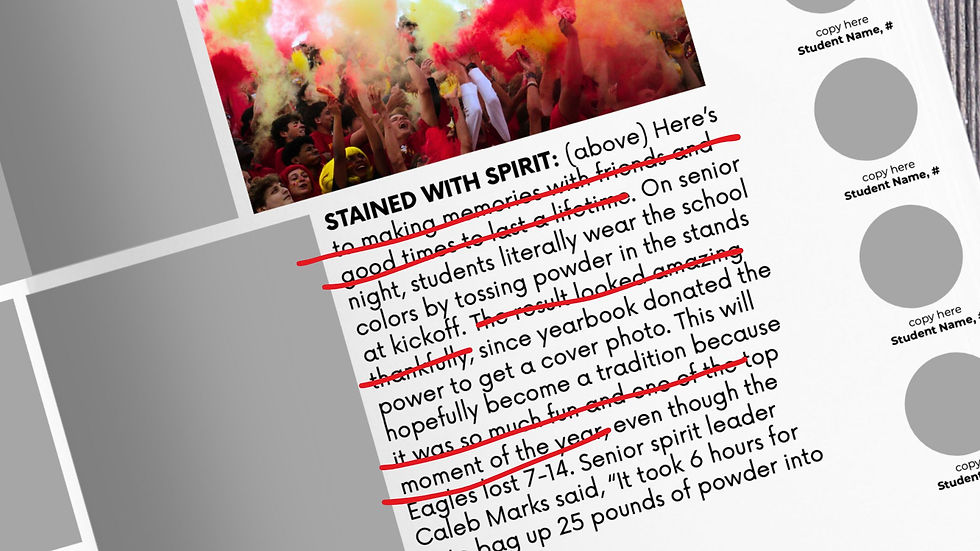
Every yearbook adviser has seen it.
You open a student’s story, read the first sentence, and discover that the football team worked hard and had fun during a season to remember. Despite facing many ups and downs, the players came together as a team, gave it their all, and made memories that will last a lifetime.
What actually happened during the season?
No one knows.
But apparently there were memories.
These phrases are what I call “delete me” content: words that occupy valuable space while communicating almost nothing. They are not necessarily grammatically incorrect. They are simply so general, predictable, and overused that they could be dropped into almost any school’s yearbook from almost any year.
That is the problem. A yearbook’s job is to preserve this year, at this school, as experienced by these students. If a sentence could survive being copied into 500 other yearbooks without anyone noticing, it probably is not doing enough journalistic work.
Welcome to the “Delete Me” Hall of Fame
The following phrases deserve recognition for their tireless service to word counts everywhere.
“They worked hard.”
Did they arrive at 5:30 a.m.? Run drills in freezing rain? Rebuild the robot three times the night before competition? Rewrite a scene until every actor knew every line?
“Worked hard” skips the evidence. Tell readers what the work looked, sounded, and felt like.
Delete-me version: The marching band worked hard to prepare its show.
Stronger version: For three weeks in July, band members crossed the practice field before 8 a.m., repeating the final formation until all 146 performers hit their marks before the last note.
“They had fun.”
This may be the most common discovery in student journalism. Students attended an event. Fun was detected. Story complete.
Instead of labeling an experience as fun, capture the moment that proves it.
Delete-me version: Students had fun at the homecoming dance.
Stronger version: When “Mr. Brightside” began, the dance floor turned into a shouting circle as seniors threw their arms around one another and supplied more enthusiasm than musical accuracy.
“It was a night to remember.”
Then help us remember it. What happened?
Delete-me version: The championship game was a night to remember.
Stronger version: With 11 seconds left, students stopped shaking the gold rally towels they had carried all night. The student section went silent long enough to hear the quarterback call the final play.
“The team came together.” "The team was bonded like brothers"
Did they resolve a disagreement? Change a tradition? Support an injured teammate? Begin eating breakfast together before Saturday practices?
“Came together” hints at a story and then walks away from it.
Delete-me version: After a difficult start, the team came together.
Stronger version: After losing three of their first four games, the players began meeting without their coaches every Monday at lunch to review mistakes and set one goal for the next game.
“They faced many challenges.”
Name one. Preferably the one involving an actual person, decision, consequence, or overturned snack table.
Delete-me version: The cast faced many challenges during the production.
Stronger version: When the lead lost her voice four days before opening night, understudy Lena Ortiz learned 63 additional lines while the rest of the cast rearranged rehearsals around her.
“Memories were made that will last a lifetime.”
This phrase has appeared in enough yearbooks to qualify for retirement benefits.
Do not announce that a memory was made. Record the memory.
Delete-me version: At senior sunrise, memories were made that will last a lifetime.
Stronger version: Wrapped in blankets on the practice field, seniors passed around powdered doughnuts and cheered when the sun finally appeared above the visitor bleachers at 7:18 a.m.
The Interview Is Usually Where the Trouble Begins
We often blame students or the source for writing or offering generic copy and responses, but generic writing frequently begins with generic reporting.
Ask, “Did you have fun at the dance?” and a source will probably say, “Yes, it was fun.” The writer then returns to class with a three-word quote and the impossible task of turning it into a compelling story.
Students need interview questions that invite scenes, stories, opinions, and specific details.
Instead of asking “Did you enjoy it?”, try:
What is one moment you wish someone had recorded?
When did you realize the event was not going as planned?
What happened that surprised you?
What detail would people who were not there never know?
What's the one moment everyone would remember?
Instead of asking “How did the team prepare?”, try:
What part of practice does the team complain about most?
Describe the hardest practice you had this season.
What changed between the beginning and end of the season?
Who did something behind the scenes that deserves recognition?
What challenges did you have to overcome to obtain the goals you set forth?
Instead of asking “How did it feel?”, try:
What was the first thought that went through your mind?
What did you do immediately afterward?
What could you hear or see at that moment?
What would you say to the version of yourself from the beginning of the year after living through this moment?
The most useful interview move is not a beautifully worded question. It is the follow-up:
“Tell me more about that.”
This is where practice comes in. Completing mock interview simulations with students who are told to provide generic responses several times, can help the interviewers improve their ability to craft a follow-up question on the spot.
Other productive follow-ups include:
What do you mean by that?
Can you give me an example? When did you see this in action?
What happened next?
Why does that moment stand out?
Can you define what you mean by __________. What does this look like?
Students sometimes treat interviews like scavenger hunts: ask five questions, collect five answers, escape. We need to teach them that the first answer is often only the doorway to the actual story.
In Action: Tips for Staff Training
Cliché Crime Scene
Provide a deliberately terrible yearbook story packed with vague language. In teams, students mark every “delete me” phrase, explain what information is missing, and develop interview questions that would help repair the story.
For an added challenge, award points for every phrase found, every useful follow-up question written, and every specific revision produced.
Follow-Up Question Challenge
One student begins with a bland response such as, “Practice was hard.” A partner must ask follow-up questions until the pair uncovers a usable anecdote or specific detail.
Count how many questions it takes to reach the real story. This activity teaches students not to accept the first vague answer as the finished interview.
Spread Editing: Delete Me Bingo
Delete Me Bingo
Create bingo cards filled with common yearbook clichés. During peer editing, students mark each phrase they locate. Those able to catch them and get a bingo win a prize
A completed row earns the spread writers no prize whatsoever—except the opportunity to revise immediately.


Comments